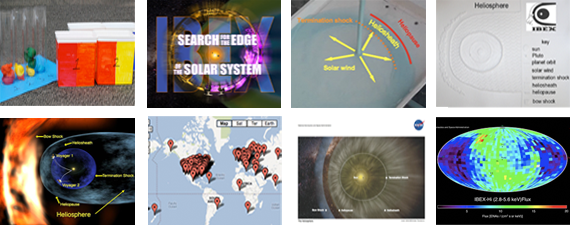
s IBEX: Interstellar Boundary Explorer
Goddard Space Flight Center and Southwest Research Institute logos + View the NASA Portal
IBEX
 
Home > Planetaria > Museums & Planetaria

Museums & Planetaria

This page will serve as a resource to Museums, planetaria, and other informal education settings. Not only will information on the IBEX mission and its background science be presented, but also materials and activities appropriate for use on the museum floor. These activities will be geared toward casual museum-goers, to inspire interest in the IBEX mission. Also included on this page will be information on the Adler-created Planetarium show focusing on the IBEX mission. Activities and demonstrations to supplement the show will be highlighted on this page, as well.

IBEX: Search for the Edge of the Solar System Planetarium Show


IBEX: Search for the Edge of the Solar System, a fulldome and flat-screen show, is available to museums, planetariums, and other non-profit institutions. This production is part of NASA's Interstellar Boundary Explorer's (IBEX) Education and Public Outreach Program, led by Adler Planetarium and with visualizations from the National Center for Supercomputing Applications (NCSA).

The show is available to museums, planetariums, and other informal and formal education venues with no licensing fee.

IBEX: Search for the Edge of the Solar System is available in the following formats:

  • Fulldome digital frames (4K, 2K, 1K frames) plus 5.1 audio
  • NEW! 1920x1080 high-definition .mov (Quicktime) file, suitable for presenting on a flat–screen video monitor or video projector connected to a computer
Find out more about obtaining IBEX: Search for the Edge of the Solar System!

The IBEX: Search for the Edge of the Solar System show is now playing at planetariums around the world.

Find a show location near you!

IBEX Show Movie Trailer

Image Credit: The Adler Planetarium

Background


IBEX: An electronic resource for museum educators, in Powerpoint (77 MB .zip file) and accessible PDF (78 MB .zip file)

This material is a comprehensive educational resource for museum educators highlighting the major mission information and science background for the Interstellar Boundary Explorer (IBEX) mission, a Small Explorer Earth–orbiting spacecraft that is designed to map the distant boundary between the solar wind from our Sun and the interstellar medium. New for 2012, this material also includes a comprehensive overview of all of the science results released through mid–2011 and information about the IBEX satellite’s orbital change in June 2011. All of this material can be modified to use with informal education audiences, including museum and planetarium visitors, after–school clubs, and others. If you need an audio version of this material, the PDF file is compatible with screen–reading software such as Adobe Acrobat Reader. The PowerPoint version is not compatible with screen–readers.

The PowerPoint .zip file contains the newly–revised PowerPoint resource and its associated movie clips.

The PDF .zip file contains a PDF version of the newly–revised PowerPoint resource, a PDF version of the Notes section for each of the slides, and the movie clips. Because movie clips cannot be embedded into the PDF slides, each movie clip file name contains its associated slide number so you can play the movie clip alongside the slide.

Please contact the IBEX Education and Public Outreach Team if you have questions about either of the .zip files.

Activities


Try these activities on the museum floor! Use one at a time, or several together to support learning about the IBEX mission and science.

Four of the States of Matter (1.7 MB; PDF)
This kinesthetic science demonstration introduces museum visitors to four of the states of matter: solid, liquid, gas, and plasma. It also demonstrates how the addition of energy can transform matter from one state to another, and gives an overview of NASA’s IBEX mission. If you need an audio version of this material, the file is compatible with screen reading software such as Adobe Acrobat Reader.

Mystery Matter (1.7 MB; PDF)
This interactive museum demonstration reintroduces participants to three of the five states of matter (solid, liquid, gas), and introduces them to a fourth state of matter, plasma, and its connection to the Sun. It also provides an overview of the IBEX mission to explore the boundary of the Solar System. If you need an audio version of this material, the file is compatible with screen reading software such as Adobe Acrobat Reader.

Achieving Orbit (943 KB; PDF)
In this Engineering Design Challenge activity, museum visitors will use balloons to investigate how a multi-stage rocket, like that used in the IBEX mission, can propel a satellite to a specific orbit. Participants will construct a two-stage balloon rocket that will be required to reach a particular location on the balloon track, simulating the proper orbit to be reached by the IBEX satellite. If you need an audio version of this material, the file is compatible with screen reading software such as Adobe Acrobat Reader.

Postcards from Space (1.6 MB; PDF)
Using information from the My Place in Space lithograph, participants will write and/or draw a postcard to friends and family as if they had gone beyond the interstellar boundary of our Solar System, into the Milky Way Galaxy. If you need an audio version of this material, the file is compatible with screen reading software such as Adobe Acrobat Reader.
Postcard for Activity

Particle Detection (601 KB; PDF)
This educator-led activity introduces museum visitors to the IBEX mission and the techniques it will use to collect and count particles called Energetic Neutral Atoms (ENAs). If you need an audio version of this material, the file is compatible with screen reading software such as Adobe Acrobat Reader.

Share Your Activity Comments With Others


Are you an educator and want to share a comment about how you have used our IBEX activities? Do you have an idea about how to implement them that might help others? Please share your thoughts with other educators on HowtoSMILE.org (free registration is required to use the full services of HowtoSMILE.org website, including commenting).

Four of the States of Matter
Mystery Matter
Achieving Orbit
Postcards from Space
Particle Detection

Posters and Lithographs


Exploring the Edge of the Solar System (poster) (English, 7.1 MB; PDF)
IBEX: Explorador de la Frontera Interestelar (Spanish, 2.5 MB; PDF)
This poster outlines the major mission highlights of the IBEX mission. If you need an audio version of this material, the file is compatible with screen reading software such as Adobe Acrobat Reader.

The Edge of the Solar System (poster) (English, 28.7 MB; PDF)
IBEX: La Frontera de Nuestro Sistema Solar (Spanish, 1.1 MB; PDF)
This poster outlines the components of our Solar System's Heliosphere. If you need an audio version of this material, the file is compatible with screen reading software such as Adobe Acrobat Reader.

Note: The previous iteration of this poster contained an error in its graphical depiction of the locations of two planets in our Solar System. Two planets were shown to occupy one planetary orbit, while an inner orbit was shown to be vacant. The current downloadable version of this product contains the correct depiction, with a single planet in each orbit. While this was a very minor element of the poster and the main content of the poster was unaffected, the IBEX Education & Public Outreach team would still like to acknowledge the error. We apologize for any inconvenience this error may have caused, and we encourage anyone who downloaded this product to replace the previous file with the one linked here. We do not anticipate reprinting the corrected version of this product to replace printed (hard) copies that have been distributed.

The Heliosphere (lithograph)(English, 2.7 MB; PDF)
La Heliosfera (Spanish, 904 KB; PDF)
This lithograph outlines the components of the Solar System's Heliosphere. If you need an audio version of this material, the file is compatible with screen reading software such as Adobe Acrobat Reader.

Note: The previous iteration of this lithograph contained an error in its graphical depiction of the locations of two planets in our Solar System. Two planets were shown to occupy one planetary orbit, while an inner orbit was shown to be vacant. The current downloadable version of this product contains the correct depiction, with a single planet in each orbit. While this was a very minor element of the lithograph and the main content of the lithograph was unaffected, the IBEX Education & Public Outreach team would still like to acknowledge the error. We apologize for any inconvenience this error may have caused, and we encourage anyone who downloaded this product to replace the previous file with the one linked here. We do not anticipate reprinting the corrected version of this product to replace printed (hard) copies that have been distributed.

Mission Overview (lithograph) (English, 745 KB; PDF)
Resumen de la Misión (Spanish, 240 KB; PDF)
This lithograph outlines the details of the IBEX mission. If you need an audio version of this material, the file is compatible with screen reading software such as Adobe Acrobat Reader.

Tactile Products for Individuals with Visual Impairment


IBEX Spacecraft Tactile

This tactile product includes a diagram of the IBEX spacecraft. If you have received this product and need the audio and/or script files, please download them here: Audio Walkthrough of the IBEX spacecraft Tactile (2.6 MB; mp3) Text version of audio walkthrough

Tactile Diagram of the IBEX Spacecraft

Image Credit: The Adler Planetarium

IBEX Heliosphere Tactile


This tactile product includes a diagram of the Heliosphere. If you have received this product and need the audio and/or script files, please download them here: Audio Walkthrough of the Heliosphere Tactile (2.8 MB; mp3) Text version of audio walkthrough

Unfortunately, all of our tactile products have been shipped out and are no longer available. If more become available, we will post this information here.

Tactile Diagram of the Heliosphere

Image Credit: The Adler Planetarium

NASA Principal Investigator: Dave McComas
E/PO Lead: Lindsay Bartolone
Webmasters: Wendy Mills & Georgina Avalos
Last Updated: 10 MAY 2012
+ Contact Us